
Compare the dependence of resistance on temperature of a superconductor with that of a normal conductor. Describe briefly the formation of Cooper pairs.
cse-2022-subject-08-006
Compare the dependence of resistance on temperature of a superconductor with that of a normal conductor. Describe briefly the formation of Cooper pairs.
Why is the Field Effect Transistor (FET) called Unipolar Transistor? Discuss how it is superior than Bipolar Junction Transistor.
Explain the drawbacks of Einstein's theory of specific heat and how it was overcome by Debye.
Show that for an n-type semiconductor, the Fermi level lies midway between the donor states and the conduction band edge at low temperature (assuming E_v=0).
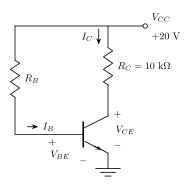
Sketch the dc load line for the circuit shown.
A solid contains a dilute concentration of \mathrm{Nd}^{3+} ions, each of which possess three 4f electrons. Assuming that there are 10^{25}\ \mathrm{m}^{-3} of these ions, calculate the magnetic susceptibility of the sample at 1\,\mathrm{K}.
An n-p-n transistor with \beta = 49 is used in common-emitter amplifier mode with V_{cc} = 10\ \mathrm{V} and R_L = 2\mathrm{k}\Omega. If a 100\mathrm{k}\Omega resistor is connected between the collector and the base of the transistor, calculate the quiescent collector current. Assume V_{BE} = 0.
An X-ray beam of wavelength \lambda_1 undergoes a first order Bragg reflection at a Bragg angle of 30^\circ. X-ray of wavelength 97\,\mathrm{nm} undergoes 3rd order reflection at a Bragg angle of 60^\circ. Consider that the two beams are reflected from the same set of planes. Find the value of \lambda_1.
Calculate the pinch-off voltage for n-channel silicon FET with a channel width of 6 \times 10^{-4}\ \mathrm{cm} and a donor concentration of 10^{15}\ \mathrm{cm}^{-3}. Given that dielectric constant of silicon is 12.
In an almost pure thick aluminium sheet, there are 0.19 atomic percent of copper at the surface and 0.18 atomic percent at a depth of 1.2\,\mathrm{mm} from the surface. Calculate the flux of the copper atoms from the surface at 550^\circ\mathrm{C}, if the diffusion coefficient of copper in aluminium at this temperature is 5.25 \times 10^{-13}\,\mathrm{m^2\,s^{-1}}. Given, Al FCC with lattice parameter, a = 4.05\,\mathring{\mathrm{A}}.
What is an intrinsic semiconductor? Intrinsic silicon has a band gap of 1.1\,\mathrm{eV} and yet at T=300\,\mathrm{K}, the conductivity is non-zero. Explain. Comment, with the help of relevant expression, on the position of the Fermi level of an intrinsic semiconductor.
The lattice parameter and the atomic mass of a diamond crystal are 3.57\,\mathring{\mathrm{A}} and 12, respectively. Calculate the density of the crystal. Given, Avogadro's number, N = 6.023 \times 10^{26}\,(\mathrm{kg\ mol})^{-1}.
Consider an amplifier with an open-loop (no feedback) gain of A and a feedback factor \beta. Derive the expression for the gain with feedback, A_f. Derive the condition for the amplifier with feedback to act as an oscillator. Comment on the change in A_f with a change in A.
Deduce the Miller indices of the close-packed planes of atoms in the f.c.c. lattice.
A 5\,\mathrm{cm^2} Ge solar cell with a dark reverse saturation current of 2\,\mathrm{nA} has solar radiation incident upon it, producing 4\times10^{17} electron-hole pairs per second. The electron and hole diffusion lengths are given to be 5\,\mu\mathrm{m} and 2\,\mu\mathrm{m}, respectively. Calculate for the cell of the following:
(i) The short-circuit current
(ii) The open-circuit voltage
Sketch the cross-sectional structure of an enhancement mode MOSFET and explain its principles of operation with the help of its output characteristics.
The angles between the tetrahedral bonds of diamond are the same as the angles between the body diagonals of a stack of neighbouring cubes having common edges and not faces. Use vector analysis to find the value of the angle.
A silicon semiconductor sample at T=300\,\mathrm{K} having cross-sectional area of 0.5\,\mu\mathrm{m}^2 has a pentavalent donor doping profile given by C(x)=5\times10^{16}e^{-x/L_n}\,\mathrm{cm^{-3}}. Given, the mobility of the electrons in the sample is 1250\,\mathrm{cm^2\,V^{-1}\,s^{-1}} and the diffusion length of the electrons, L_n, is 4\,\mu\mathrm{m}. Calculate the diffusion current in the sample at distance x=2\,\mu\mathrm{m}.
A silicon semiconductor sample is doped with 6\times10^{16}\,\mathrm{cm^{-3}} of aluminium and 7\times10^{15}\,\mathrm{cm^{-3}} of phosphorus atoms. Given at T=300\,\mathrm{K}, the intrinsic carrier concentration, n_i=1.5\times10^{10}\,\mathrm{cm^{-3}}; the band gap, E_g=1.1\,\mathrm{eV}; the electron mobility, \mu_n=1250\,\mathrm{cm^2\,V^{-1}\,s^{-1}} and the hole mobility, \mu_p=480\,\mathrm{cm^2\,V^{-1}\,s^{-1}}. Determine in the sample of the following:
(i) The type of the semiconductor, n or p
(ii) The hole carrier concentration
(iii) The electron carrier concentration
(iv) The position of the Fermi level in the sample with respect to the bottom of the conduction band
(v) The conductivity of the sample
Consider a face-centred cubic lattice of side a. Deduce –
(i) The primitive translation vectors;
(ii) The volume of the primitive cell;
(iii) The reciprocal primitive translation vectors;
(iv) The volume of the reciprocal lattice