
Explain the cause of hysteresis phenomenon in ferromagnetic materials. What does the area of the hysteresis loop signify?
cse-2025-subject-08-003
Explain the cause of hysteresis phenomenon in ferromagnetic materials. What does the area of the hysteresis loop signify?
How does n-channel FET differ from p-channel FET?
(i) What is the origin of paramagnetism ? Discuss the temperature dependence of paramagnetic susceptibility. (ii) Calculate the diamagnetic susceptibility of atomic Hydrogen in the ground state at STP. Assume the mean square distance of electronic charge distribution of atomic Hydrogen from the nucleus r^2 = 3 a_0^2, a_0 being the radius of the first Bohr orbit of Hydrogen.
(i) What is the concept of effective mass of the electron ? (ii) The energy near a valence band edge is given by E(k) = -1 \times 10^{-26} k^2\text{ ergs}. An electron is removed from the orbital k = 1 \times 10^7 k_x\text{ cm}^{-1}. Find the sign and magnitude of effective mass of the hole.
The spacing between successive (100) planes in sodium chloride is 1\cdot 41\text{ \AA}. X-rays incident on the surface of the crystal are found to give rise to second order Bragg reflections at a glancing angle 10^\circ. Calculate the wavelength of X-ray radiations.
An RC-coupled transistor amplifier has mid-frequency gain A_{\text{vm}} = 100. The values of the lower and upper cut-off frequencies are f_1 = 20\text{ Hz} and f_2 = 50\text{ kHz}. Find the frequencies at which the gain is reduced to 80.
Give logic diagram, Boolean equation and truth tables of AND, OR and NOT gates. Show that NAND and NOR gates can be utilized as a Universal Gate.
Compare the working of FET and MOSFET with their structure, I-V curve and transfer characteristics.
How is digital system different from analog system ? What are the principal reasons for the widespread use of digital electronics ?
How does supercritical magnetic field depend on temperature ? For a superconducting specimen, the critical magnetic fields are respectively 1\cdot 45 \times 10^5\text{ A/m} and 4\cdot 2 \times 10^5\text{ A/m} for 14\text{ K} and 13\text{ K}. Determine the superconducting transition temperature and the critical field at 0\text{ K}.
With a neat circuit diagram, explain the working of Wien-Bridge oscillator.
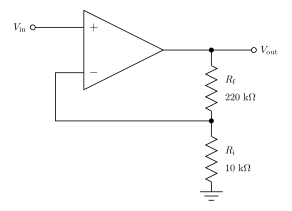
(i) Determine the input and output impedances of the amplifier in given figure. The op-amp datasheet gives Z_{\text{in}} = 2\text{ M}\Omega, Z_{\text{out}} = 75\ \Omega and A_{\text{ol}} = 200,000 (open loop voltage gain). (ii) Find the closed-loop voltage gain.
Show that the Fermi level shifts upward, closer to the conduction band in an n-type semiconductor and shifts downward, closer to the valence band in a p-type semiconductor.
Explain classical theory of diamagnetism. Show that the susceptibility of diamagnetic substances is directly proportional to the atomic number. Why all the electrons in an atom contribute to diamagnetism ?
Derive an expression for the specific heat of a solid based on the Debye theory and show how it agrees with the experimental values. What is the most important assumption of Debye theory in comparison to Einstein theory ? Is there any drawback of Debye theory ?
Derive diffraction conditions using reciprocal lattice concept. What are these conditions known as ?
Explain the drawbacks of Einstein's theory of specific heat and how it was overcome by Debye.
Explain why Type-II superconductor is better than Type-I superconductor in the application of superconductor magnets.
Why is the Field Effect Transistor (FET) called Unipolar Transistor? Discuss how it is superior than Bipolar Junction Transistor.
Compare the dependence of resistance on temperature of a superconductor with that of a normal conductor. Describe briefly the formation of Cooper pairs.