
Explain a solar cell employing its characteristics on output quantity Venus quantities like load current, radiance and temperature.
cse-2001-subject-08-004
Explain a solar cell employing its characteristics on output quantity Venus quantities like load current, radiance and temperature.
(i) FETs have unique properties which make BJTs not suitable for some important applications. What are these most important FET applications? (ii) Briefly describe FETs as variable resistors.
(i) Give a qualitative account of BCS theory of superconductivity. (ii) Obtain an expression for conductivity of an intrinsic semiconductor. How does it vary with temperature? (iii) The resistivity of an intrinsic semiconductor is 4.5\text{ ohm-m} at 20^\circ\text{C} and 2.0\text{ ohm-m} at 32^\circ\text{C}. Calculate the energy band gap.
Which one of these mechanisms shows a negative dynamic resistance? Why?
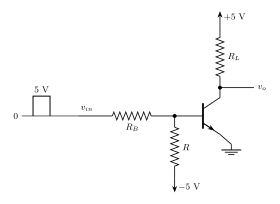
A circuit of a NOT gate is given in the figure below. Explain how you will determine the values of the resistances R_B, R and R_L.
Discuss the different breakdown mechanisms for a reverse biased Zener diode.
Explain why superconductors are perfect diamagnets.
What are the salient characteristics of ferromagnetic ? Explain how the Curie law of paramagnetism is modified to the Curie - Weiss law.
A Zener diode of 1\text{ W} power has a dynamic resistance of 10\text{ m}\Omega at the breakdown voltage of 3\text{ V}. What will be the fluctuations in the current through the diode if the voltage fluctuates by 100\text{ mV}? What will happen to the diode ? Why?
Do these mechanisms have different temperature coefficients? Explain.
A junction diode in series with a parallel combination of a large resistor and a capacitor acts as a linear detector of amplitude modulated waves. Explain the action.
Phosphorous is doped in a silicon wafer. The impurity concentration is 10^{13}\text{ per cm}^3. If all the donors are active calculate its resistivity at room temperature. The mobility of electrons is 1250\text{ cm}^2/\text{V-s}.
How is frequency modulation advantageous compared to amplitude modulation? Still, why are the video signals transmitted by television stations amplitude modulated?
What is Meissner effect? Superconducting tin has a critical temperature of 3.7 K in zero magnetic field and critical field at 0 K is 306 gauss. Determine the critical field at 2K.
Simplify the given Boolean expression and draw the corresponding logic circuit using NAND gates: Y = (\bar{A} + B + C) . (\bar{A} + \bar{B} + C)
What is the photovoltaic mode of operation for a photo-diode? Describe the construction and working of a silicon solar cell.
Explain the working N-P-N transistor. Derive expression for the current and voltage gains.
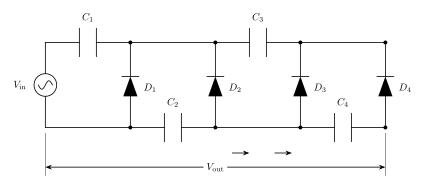
If E_0 is the peak value of the input voltage V_{in} calculate the output voltage V_{out}.
Distinguish qualitatively between dia-, para-, ferro-, antiferro- and ferrimagnetism. How is the weak and temperature independence paramagnetism of metals explain?
Simplify the following logic function and draw the corresponding logic diagram:- Y = (A+B).(A + C).(B+C)