Starting with the expression for the density of states for electrons in a band, show that the Fermi energy of an intrinsic semiconductor is at the middle of the band gap. Use these results to estimate the electron density at 300 K (Assuming E_g=1\,\mathrm{eV} and the rest masses of electron and hole as m_e and m_h).
A perfect conductor and a superconductor with T_c \sim 10\ \mathrm{K} are subjected to the following conditions:
(i) cooled under applied magnetic field to 4\ \mathrm{K}
(ii) cooled to 4\ \mathrm{K} and then magnetic field is applied with schematic diagrams, explain path of magnetic field lines in all these situations.
Show that the London equation \vec{\nabla} \times \vec{J} = -\frac{1}{\mu_0\lambda_L^2}\vec{B} or \vec{j} = -\frac{c}{4\pi n\lambda_L^2}\vec{A} leads to the Meissner effect.
Draw and explain the collector characteristics of a bipolar junction transistor in common emitter configuration. Using the plot, explain how the transistor can be used as an ON-OFF switch.
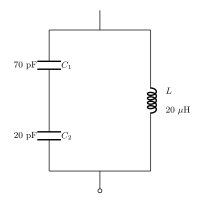
Explain how the circuit shown above can be a source of oscillations. Use this circuit to construct a transistor oscillator and explain its working. What is the frequency of oscillations of this circuit?
Construct a digital circuit to add three bits A, B and C and provide their sum and carry as outputs. Show appropriate Boolean expressions and truth table to justify the outputs.
Prove the following Boolean identity and draw its gates equivalent : Y = \bar{B}(A + C) + C(\bar{A} + B) + AC
In an operational amplifier, the amplifier gain is 10000. The input series resistance is 100\text{ k}\Omega and the feedback resistance is 500\text{ k}\Omega. If the input voltage is 1\text{ volt}, find the exact output voltage and percentage error considering an infinite gain for the amplifier.
What is a thermistor? Discuss static characteristics of a thermistor. What is its time constant?
Write down London second equation for superconductors. Explain how it accounts for the Meissner effect.
Explain the variation of Magnetisation of Type I and Type II superconductors as a function of applied magnetic field.
Classify diamagnetic, paramagnetic and ferromagnetic materials in terms of their magnetic susceptibility \psi. Plot and explain the variation of \frac{1}{\psi} with temperature for the three materials.
(i) What is De Morgan's law ? (ii) Simplify the Boolean expression A + AB + ABC + ABCD
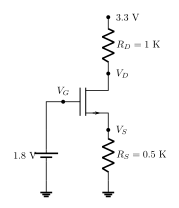
The above circuit exhibits a MOSFET with a source resistor. It has V_T = 1\text{ V} and \mu_n C_{ox} (W/L) = 2\text{ mA/V}^2. Calculate the drain voltage. Also determine whether the transistor is in saturation or in the triode region.
What is Meissner effect ? Determine the magnetic susceptibility of a superconductor. Explain whether a superconductor exhibits perfect ferromagnetism, paramagnetism or diamagnetism.
A type I superconductor with T_c = 7\text{ K} has slope \frac{dB_c}{dT} = -25\text{ mT/K} at transition temperature T_c. Estimate its critical field at 6\text{ K}.
A power supply using a full-wave rectifier is to provide 100\text{ mA} at 20\text{ V} with no more than 1\% ripple. Calculate the minimum value of smoothing capacitor used. Consider the diode resistance and the resistance of the secondary of the transformer as negligible. Also take ripple frequency as 50\text{ cycles per second}.
For a simple cubic, a face centered cubic and a body centered cubic crystal, determine the atomic packing factor. How many atoms per \text{mm}^2 surface area are there in (100) plane for leads which has f.c.c. structure. The radius of the atoms is 0\cdot 174\text{ nm}.
Metallic iron undergoes a structural phase transition from bcc to fcc at 910^\circ\mathrm{C}. At this temperature, the atomic radii of iron atoms in the bcc and fcc structures are 0.126 \times 10^{-9}\,\mathrm{m} and 0.129 \times 10^{-9}\,\mathrm{m} respectively. Calculate the volume change in percentage during this structural change.
Explain the race problem encountered in an RS latch and how it can be avoided. Build a Mod-10 counter using JK flip-flops and explain its working.