
Use the uncertainty principle to estimate the ground state energy of a linear harmonic oscillator.
cse-2012-subject-05-001
Use the uncertainty principle to estimate the ground state energy of a linear harmonic oscillator.
Estimate the size of the hydrogen atom and the ground state energy from the uncertainty principle.
Let \vec{\sigma} be the vector operator with component equal to Pauli's spin matrices \sigma_x,\sigma_y,\sigma_z. If \vec{a} and \vec{b} are vectors in 3D space, prove the identity (\vec{\sigma}\cdot\vec{a})(\vec{\sigma}\cdot\vec{b})=\vec{a}\cdot\vec{b}+i\vec{\sigma}\cdot(\vec{a}\times\vec{b})
The normalized wave function for the electron in the ground state of the hydrogen atom is given by \psi(r)=\frac{1}{(\pi a_0^3)^{1/2}}e^{-r/a_0} where a_0 is the radius of the first Bohr orbit. Calculate \langle r\rangle and \left\langle\frac{1}{r}\right\rangle.
Normalize the wave function \psi(x)=e^{-\lvert x\rvert}\sin\alpha x
Solve the Schrödinger equation for a particle of mass m in an infinite rectangular well defined by V(x)=\begin{cases} 0\ ;\ 0\leq x\leq L\\ \infty\ ;\ x<0,\,x>L \end{cases} Obtain the normalized eigen functions and the corresponding eigen values.
Show that {}^2S_{\frac{1}{2}}, {}^2P_{\frac{1}{2}} and {}^2P_{\frac{3}{2}} levels of sodium spectrum are split in the ratio of 3:1:2 due to anomalous Zeeman effect.
Calculate (\Delta x)^2, where \Delta x = x - \langle x \rangle.
Calculate the wavelength of de Broglie waves associated with electrons accelerated through a potential difference of 200 Volts.
A system is described by the Hamiltonian operator, H=-\dfrac{d^2}{dx^2}+x^2. Show that the function A x\exp\left(-\dfrac{x^2}{2}\right) is an eigen function of H. Determine the eigen values of H.
The normalized wave function for the electron in hydrogen atom for the ground state is \psi(r)=(\pi a_0^3)^{-1/2}\exp\left(-\frac{r}{a_0}\right) Where a_0 is the radius of the first Bohr orbit. Show that the most probable position of the electron is a_0.
Show that the Pauli spin matrices satisfy the following: \sigma_x^2=\sigma_y^2=\sigma_z^2=1 \sigma_x\sigma_y=-\sigma_y\sigma_x=i\sigma_z \sigma_y\sigma_z=-\sigma_z\sigma_y=i\sigma_x \sigma_z\sigma_x=-\sigma_x\sigma_z=i\sigma_y
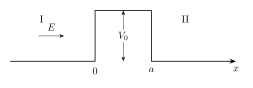
A stream of particles of mass M and energy E is directed from left to a one-dimensional potential barrier as shown in the above figure. Set up the time-independent Schrodinger equation and obtain an expression for transmission probability from region I to II. How this phenomenon helps in the understanding of \alpha-decay of nuclei?
Derive Bohr's angular momentum quantization condition in Bohr's atomic model from the concept of de Broglie waves.
(i) Explain spin-orbit coupling of an atomic electron. (ii) Show that the 2p state in the H atom splits up into two substates due to spin-orbit coupling. (iii) Calculate the energy of separation in eV, resulting from the spin-orbit coupling when the magnetic field experienced by the electron is 0 \cdot 4 \text{ T}.
Show that the Pauli Spin Matrices obey the following relations : (i) \text{Tr} (\sigma_x) = \text{Tr} (\sigma_y) (ii) \det (\sigma_y) = \det (\sigma_z) (iii) The eigenvalues of \sigma_z and \sigma_x are the same. (iv) Write down the y-component of the spin angular momentum matrix corresponding to an antineutrino.
Using dimensional analysis, explain why the angular momentum of a particle cannot be \hbar^2.
(i) Consider a particle in a three-dimensional box. Derive an expression for g(E), the density of states. (ii) Show that \frac{g(p)}{g(E)} = \frac{dE}{dp} , where g(p) is the density of states in the momentum space. Deduce that g(p) is proportional to p^2 for a free non-relativistic particle.
Show that the time-dependent part of all the solutions of the Schrödinger equation in one-dimension has the structure \phi(t) = \exp (- i E t / h), provided the potential is not an explicit function of time.
(i) Consider a positron in a box. If the energy released is 60 \text{ eV} when it jumps from the third excited state to the ground state, show that the width of the potential is nearly 0 \cdot 3 \text{ nm}. (ii) Prove that the most probable distance of an electron from the proton (in the hydrogen atom) is the Bohr radius of the hydrogen atom. Consider only the ground state.