
Solve the eigen value equation L^2 Y(\theta, \phi) = \lambda \hbar^2 Y(\theta, \phi) and obtain the eigen values and eigen functions of L^2.
ifos-2011-subject-05-004
Solve the eigen value equation L^2 Y(\theta, \phi) = \lambda \hbar^2 Y(\theta, \phi) and obtain the eigen values and eigen functions of L^2.
For a quantum mechanical system prove that all energy eigen-values E_n are real and if E_n \neq E_k, then the corresponding eigen functions are orthogonal.
On the basis of uncertainty principle calculate the size of Hydrogen atom.
Set up a time-independent Schrödinger equation for a linear harmonic oscillator and obtain the energy eigen values. Explain the significance of zero point energy.
Estimate the number of states lying in an energy interval of 0.03\text{ eV} above the Fermi level in a potassium crystal of unit volume. (E_F = 2.12\text{ eV} for potassium)
The electron spin operator \hat{s} can be expressed in matrix form in terms of the Pauli spin operator, \hat{\sigma} as \hat{\sigma} = 2\hat{s} where \sigma_x = \begin{pmatrix} 0 & 1 \\ 1 & 0 \end{pmatrix}, \quad \sigma_y = \begin{pmatrix} 0 & -i \\ +i & 0 \end{pmatrix}, \quad \sigma_z = \begin{pmatrix} 1 & 0 \\ 0 & -1 \end{pmatrix} Show that \sigma_x^2 = \sigma_y^2 = \sigma_z^2 = 1 \quad \text{and} \sigma_x \sigma_y = -\sigma_y \sigma_x = i \sigma_z \sigma_y \sigma_z = -\sigma_z \sigma_y = i \sigma_x \sigma_z \sigma_x = -\sigma_x \sigma_z = i \sigma_y
Set up the time-independent Schrödinger equation for an electron moving in a Coulomb field, V(r) = \frac{-ze^2}{4\pi\varepsilon_0 r}, in polar coordinates. Solve the radial equation to get the energy eigen values.
A stream of particles of mass M and energy E is directed from left to a one-dimensional potential well, as shown below :
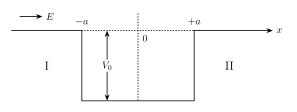
The potential is -V_0 in the region a \ge x \ge -a and zero elsewhere. Set up a time-independent Schrödinger equation and obtain an expression for the transmission ratio from region I to II. Discuss the result. Show that there is a finite reflection from such a potential well, which is a result of the wave nature of matter.