
Write the time independent Schrödinger equation for a bouncing ball.
cse-2015-subject-05-004
Write the time independent Schrödinger equation for a bouncing ball.
Establish that: hc = 1240\ \mathrm{eV\,nm} = 1240\ \mathrm{MeV\,fm}
A particle trapped in an infinitely deep square well of width a has a wave function \psi=\left(\frac{2}{a}\right)^{1/2}\sin\left(\frac{\pi x}{a}\right). The walls are suddenly separated by infinite distance. Find the probability of the particle having momentum between p and p+dp.
What is Zeeman effect? How can it be understood on the basis of quantum mechanics?
An electron is moving in a one-dimensional box of infinite height and width 1\,\mathring{\mathrm{A}}. Find the minimum energy of electron.
The mean life of Lambda (\Lambda^0) particle is 2.6 \times 10^{-10}\,\mathrm{s}. What will be the uncertainty in the determination of its mass in \mathrm{eV}?
Obtain the time-dependent Schrödinger equation for a particle. Hence deduce the time independent Schrödinger equation.
Solve the Schrödinger equation for a particle of mass m confined in one dimensional potential well of the form: V(x)= \begin{cases} 0; & 0 \leq x \leq L,\\ \infty; & x<0,\ x>L. \end{cases} Obtain the discrete energy values and the normalized eigen functions.
If \hat{x} and \hat{p} are the position and momentum operators, prove the commutation relation [\hat{p}^{2},\hat{x}]=-2i\hbar\hat{p}.
Write down Pauli spin matrices. Express J_x,J_y and J_z in terms of Pauli spin matrices.
Using the commutation relations [x,p_x]=[y,p_y]=[z,p_z]=i\hbar deduce the commutation relation between the components of angular momentum operator \mathbf{L}. [L_x,L_y]=i\hbar L_z [L_y,L_z]=i\hbar L_x\quad\text{and}\quad [L_z,L_x]=i\hbar L_y.
Find the de Broglie wave length of
(i) a neutron
(ii) an electron moving with kinetic energy of 500\,eV (1\,eV = 1.602 \times 10^{-19}\,J)
The normalized wave function for the electron in the ground state of the hydrogen atom is given by \psi(r)=\dfrac{1}{\sqrt{\pi a_0^3}}e^{-r/a_0}, where a_0 is the radius of the first Bohr orbit. Calculate the probability of finding the electron within a distance r_0 of the proton in the ground state.
Using the definition \vec{L}=\vec{r}\times\vec{p} of the orbital angular momentum operator, evaluate [L_x,L_y].
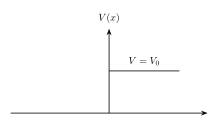
(i) Consider a beam of particles incident on a one-dimensional step function potential with energy E > V_0 as shown in the above figure. Solve the Schrödinger equation and obtain expressions for the reflection and transmission coefficients.
(ii) What are the limits of the reflection coefficient for E \to V_0 and E \to \infty?
(iii) Discuss the cases 0 < E < V_0 and E < 0.
Show that the velocity of electron in the first orbit of hydrogen atom is \left(\frac{1}{137}\right)C where C is the velocity of light. (Given electronic charge = 1.602 \times 10^{-1}\ \mathrm{C} Planck Constant 6.63 \times 10^{-34}\ \mathrm{J.s}, permittivity = 8.85 \times 10^{-1}\ \mathrm{C^2\ N^{-1}\ m^{-2}})
In a series of experiments on the determination of the mass of a certain elementary particle, the results showed a variation of \pm 20\,m_e, where m_e is the electron mass. Estimate the lifetime of the particle.
Given that \sigma_x,\sigma_y,\sigma_z are Pauli spin operators, prove the following relationships:
(i) \sin(\sigma_x\varphi)=\sigma_x\sin\varphi
(ii) \cos(\sigma_z\varphi)=\cos\varphi
(i) Solve the radial part of the time-independent Schrödinger equation for a hydrogen atom. Obtain an expression for the energy eigenvalues.
(ii) What is the degree of degeneracy of the energy eigenvalues? What happens if the spin of the electron is taken into account?
Consider the one-dimensional wavefunction \psi(x)=Axe^{-kx}, (0\leq x\leq\infty;\,k>0)
(i) Calculate A so that \psi(x) is normalized.
(ii) Using Schrödinger's equation find the potential V(x) and energy E for which \psi(x) is an eigenfunction. (Assume that as x \to \infty, V(x) \to 0).