A particle of mass m is confined in a one dimensional box on the x-axis between x = 0 and x = L. Obtain the allowed energy states of the particle and the corresponding eigenfunctions. What will be the energy pattern in the limit of L \to \infty ?
Describe the differences in the behaviour of a quantum harmonic oscillator with the corresponding classical oscillator.
Show that
(i) \hat{L} \times \hat{L} = i \hbar \hat{L}
(ii) [\hat{L}_+, \hat{L}_-] = 2\hbar \hat{L}_z
(iii) \hat{\sigma}_x \hat{\sigma}_y \hat{\sigma}_z = -i
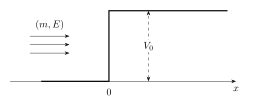
A beam of particles of mass m and energy E is incident on a step potential of height V_0 from the left as shown in the figure. Discuss the behaviour of the particle for (i) E < V_0 and (ii) E > V_0. Obtain expressions for the reflection and the transmission coefficients and sketch them as a function of the incident energy of the particle.
An electron is described by the following wave function : \begin{aligned} \psi(x) &= 0 && \text{for } x < 0 \\ &= C e^{-x}(1 - e^{-x}) && \text{for } x \ge 0 \end{aligned} where C is a constant. Find out the average position of the electron.
Use the uncertainty principle to estimate the binding energy of the hydrogen atom in the ground state in terms of m_\text{e}, e, \hbar and c. Estimate the answer in eV.
Recall the Pauli matrix representation of two-state system of electron, \sigma_x, \sigma_y, \sigma_z, and show that they do not commute.
Consider a one-dimensional harmonic oscillator potential V(x) = \frac{1}{2} m \omega_0^2 x^2 where m represents the mass of a particle, \omega_0 is the classical frequency of the oscillator and x is the displacement from equilibrium position. Obtain the solution of the corresponding Schrödinger equation. Using the normalization condition on the solution, show that the ground-state wave function has the form \psi_0(x) = \left( \frac{\alpha}{\pi} \right)^{1/2} e^{-\frac{1}{2} \alpha^2 x^2} \alpha = \left( \frac{m \omega_0}{\hbar} \right)^{1/2}
Obtain the solution of one-dimensional free particle Schrödinger equation. Show that it corresponds to plane monochromatic (constant angular frequency) wave.
In a nuclear experiment, beams of electrons and protons are moving with velocities c / 10 and c / 20 respectively. Calculate the de Broglie wavelengths of both the particles in metre (c is the speed of light = 3 \times 10^8\text{ m / s}).
Explain the phenomenon of Zeeman effect of atomic physics.
Consider a two-electron system in ground state with orbital quantum number zero (l = 0). Use Pauli's exclusion principle to obtain orientations of the two electrons.
What does the uncertainty principle signify? Consider an electron in a box of size 10^{-10}\text{ m}. What will be its maximum uncertainty in momentum?
Deduce the commutation relations between the components of angular momentum operator \mathbf{L} [L_x, L_y] = i \hbar L_z [L_y, L_z] = i \hbar L_x [L_z, L_x] = i \hbar L_y using the commutation relations [x, p_x] = [y, p_y] = [z, p_z] = i \hbar
Determine the values of the total angular momentum for a 3d electron.
Calculate the most probable value of 'r' for an electron in the ground state of the hydrogen atom.
Solve the Schrödinger equation for an electron of mass m confined in a one-dimensional potential well of the form
\begin{align*} V &= 0 \text{ when } 0 \le x \le L \\ &= \infty \text{ when } x < 0; \ x > L \end{align*}
Obtain the discrete energy levels and the normalized eigen functions.
Find the de Broglie wavelength of a neutron moving with a kinetic energy of 500\text{ eV}. (1\text{ eV} = 1\cdot 602 \times 10^{-19}\text{ J})
Give an account of Heisenberg's Uncertainty principle. Outline an idealised experiment to bring out its significance.
What is the de Broglie wavelength of an electron whose kinetic energy is 100\text{ eV} ?