Let \vec{\sigma} be the vector operator with component equal to Pauli's spin matrices \sigma_x,\sigma_y,\sigma_z. If \vec{a} and \vec{b} are vectors in 3D space, prove the identity (\vec{\sigma}\cdot\vec{a})(\vec{\sigma}\cdot\vec{b})=\vec{a}\cdot\vec{b}+i\vec{\sigma}\cdot(\vec{a}\times\vec{b})
The normalized wave function for the electron in the ground state of the hydrogen atom is given by \psi(r)=\frac{1}{(\pi a_0^3)^{1/2}}e^{-r/a_0} where a_0 is the radius of the first Bohr orbit. Calculate \langle r\rangle and \left\langle\frac{1}{r}\right\rangle.
Normalize the wave function \psi(x)=e^{-\lvert x\rvert}\sin\alpha x
Solve the Schrödinger equation for a particle of mass m in an infinite rectangular well defined by V(x)=\begin{cases} 0\ ;\ 0\leq x\leq L\\ \infty\ ;\ x<0,\,x>L \end{cases} Obtain the normalized eigen functions and the corresponding eigen values.
Show that {}^2S_{\frac{1}{2}}, {}^2P_{\frac{1}{2}} and {}^2P_{\frac{3}{2}} levels of sodium spectrum are split in the ratio of 3:1:2 due to anomalous Zeeman effect.
Calculate (\Delta x)^2, where \Delta x = x - \langle x \rangle.
Estimate the size of the hydrogen atom and the ground state energy from the uncertainty principle.
Calculate the wavelength of de Broglie waves associated with electrons accelerated through a potential difference of 200 Volts.
(i) What angles do the \vec{L} \text{(vector)} make with the z-axis when l = 2 for an electron ? (ii) Determine the values of the total angular momentum for a 3d electron.
What are Pauli spin matrices ? Show that : (\vec{\sigma}\cdot\vec{A})(\vec{\sigma}\cdot\vec{B}) = \vec{A}\cdot\vec{B} + i\vec{\sigma}\cdot(\vec{A}\times\vec{B}) where \vec{\sigma} are the Pauli spin matrices and \vec{A} and \vec{B} are vector operators which commute with \vec{\sigma}, but do not necessarily commute with each other.
On the basis of uncertainty principle calculate the size of Hydrogen atom.
Solve the eigen value equation L^2 Y(\theta, \phi) = \lambda \hbar^2 Y(\theta, \phi) and obtain the eigen values and eigen functions of L^2.
The normalized wave function for the electron in hydrogen atom for the ground state is \psi(r)=(\pi a_0^3)^{-1/2}\exp\left(-\frac{r}{a_0}\right) Where a_0 is the radius of the first Bohr orbit. Show that the most probable position of the electron is a_0.
Set up the time-independent Schrödinger equation for an electron moving in a Coulomb field, V(r) = \frac{-ze^2}{4\pi\varepsilon_0 r}, in polar coordinates. Solve the radial equation to get the energy eigen values.
The electron spin operator \hat{s} can be expressed in matrix form in terms of the Pauli spin operator, \hat{\sigma} as \hat{\sigma} = 2\hat{s} where \sigma_x = \begin{pmatrix} 0 & 1 \\ 1 & 0 \end{pmatrix}, \quad \sigma_y = \begin{pmatrix} 0 & -i \\ +i & 0 \end{pmatrix}, \quad \sigma_z = \begin{pmatrix} 1 & 0 \\ 0 & -1 \end{pmatrix} Show that \sigma_x^2 = \sigma_y^2 = \sigma_z^2 = 1 \quad \text{and} \sigma_x \sigma_y = -\sigma_y \sigma_x = i \sigma_z \sigma_y \sigma_z = -\sigma_z \sigma_y = i \sigma_x \sigma_z \sigma_x = -\sigma_x \sigma_z = i \sigma_y
Estimate the number of states lying in an energy interval of 0.03\text{ eV} above the Fermi level in a potassium crystal of unit volume. (E_F = 2.12\text{ eV} for potassium)
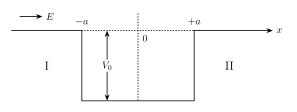
A stream of particles of mass M and energy E is directed from left to a one-dimensional potential well, as shown below :
The potential is -V_0 in the region a \ge x \ge -a and zero elsewhere. Set up a time-independent Schrödinger equation and obtain an expression for the transmission ratio from region I to II. Discuss the result. Show that there is a finite reflection from such a potential well, which is a result of the wave nature of matter.
Set up a time-independent Schrödinger equation for a linear harmonic oscillator and obtain the energy eigen values. Explain the significance of zero point energy.
Derive Bohr's angular momentum quantization condition in Bohr's atomic model from the concept of de Broglie waves.
A system is described by the Hamiltonian operator, H=-\dfrac{d^2}{dx^2}+x^2. Show that the function A x\exp\left(-\dfrac{x^2}{2}\right) is an eigen function of H. Determine the eigen values of H.