
Solve the Schrödinger equation for a particle in a three-dimensional rectangular potential barrier. Explain the terms degenerate and non-degenerate states in this context.
cse-2015-subject-05-005
Solve the Schrödinger equation for a particle in a three-dimensional rectangular potential barrier. Explain the terms degenerate and non-degenerate states in this context.
Write the time independent Schrödinger equation for a bouncing ball.
What is Zeeman effect? How can it be understood on the basis of quantum mechanics?
Using the commutation relations [x,p_x]=[y,p_y]=[z,p_z]=i\hbar deduce the commutation relation between the components of angular momentum operator \mathbf{L}. [L_x,L_y]=i\hbar L_z [L_y,L_z]=i\hbar L_x\quad\text{and}\quad [L_z,L_x]=i\hbar L_y.
Explain the origin of the anomalous Zeeman effect.
What is the de Broglie wavelength of an electron whose kinetic energy is 100\text{ eV} ?
Using WKB approximation find out the lifetime of \alpha-emitter.
Normalize the ground state wave function \psi_0(x) = A e^{(-\alpha x^2/2)} for the simple harmonic oscillator and find expectation values \langle x \rangle and \langle x^2 \rangle.
Derive an expression for transmission coefficient for a particle through a rectangular potential barrier.
Show that
(i) no two of the three components of angular momentum operator commute and
(ii) the third component of the angular momentum operator commutes with the square of angular momentum operator.
Find the de Broglie wave length of
(i) a neutron
(ii) an electron moving with kinetic energy of 500\,eV (1\,eV = 1.602 \times 10^{-19}\,J)
The mean life of Lambda (\Lambda^0) particle is 2.6 \times 10^{-10}\,\mathrm{s}. What will be the uncertainty in the determination of its mass in \mathrm{eV}?
Obtain the time-dependent Schrödinger equation for a particle. Hence deduce the time independent Schrödinger equation.
Solve the Schrödinger equation for a particle of mass m confined in one dimensional potential well of the form: V(x)= \begin{cases} 0; & 0 \leq x \leq L,\\ \infty; & x<0,\ x>L. \end{cases} Obtain the discrete energy values and the normalized eigen functions.
An electron is moving in a one-dimensional box of infinite height and width 1\,\mathring{\mathrm{A}}. Find the minimum energy of electron.
If \hat{x} and \hat{p} are the position and momentum operators, prove the commutation relation [\hat{p}^{2},\hat{x}]=-2i\hbar\hat{p}.
Write down Pauli spin matrices. Express J_x,J_y and J_z in terms of Pauli spin matrices.
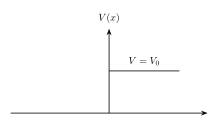
(i) Consider a beam of particles incident on a one-dimensional step function potential with energy E > V_0 as shown in the above figure. Solve the Schrödinger equation and obtain expressions for the reflection and transmission coefficients.
(ii) What are the limits of the reflection coefficient for E \to V_0 and E \to \infty?
(iii) Discuss the cases 0 < E < V_0 and E < 0.
Show that the velocity of electron in the first orbit of hydrogen atom is \left(\frac{1}{137}\right)C where C is the velocity of light. (Given electronic charge = 1.602 \times 10^{-1}\ \mathrm{C} Planck Constant 6.63 \times 10^{-34}\ \mathrm{J.s}, permittivity = 8.85 \times 10^{-1}\ \mathrm{C^2\ N^{-1}\ m^{-2}})
In a series of experiments on the determination of the mass of a certain elementary particle, the results showed a variation of \pm 20\,m_e, where m_e is the electron mass. Estimate the lifetime of the particle.