
Describe Michelson-Morley experiment with the help of a diagram. Discuss why it is considered as the 'most famous failed experiment'.
ifos-2020-subject-01-008
Describe Michelson-Morley experiment with the help of a diagram. Discuss why it is considered as the 'most famous failed experiment'.
A rod of length L_0 moves with speed v along the horizontal direction. The rod makes an angle \theta_0 with respect to the x'-axis. (i) Determine the length of the rod as measured by a stationary observer. (ii) Determine the angle \theta the rod makes with the x-axis. (v is comparable to c)
Two spaceships approach each other, each moving with the same speed as measured by a stationary observer on the Earth. Their relative speed is 0{\cdot}7c. Determine the velocity of each spaceship as measured by the stationary observer on the Earth.
(i) Explain Coriolis force. Compare the qualitative effects of the Coriolis forces in the two geographical hemispheres of the Earth for rivers flowing east. (ii) With schematic, explain Foucault's pendulum.
Derive Euler-Lagrange equations of motion from Hamilton's principle for any bilateral holonomic system having no non-potential forces and n degree of freedom. Can it be applied to non-holonomic systems?
A rocket of mass m_1 + m_2 is launched with a velocity whose horizontal and vertical components are u_x and u_y. At the highest point in its path, the rocket explodes into two parts of masses m_1 and m_2 that separate in a horizontal direction in the original plane of motion. Show that the fragments strike the ground at a distance apart given by D = \frac{u_y}{g} \sqrt{\frac{2(m_1 + m_2)K}{m_1 m_2}} where K is the kinetic energy produced by the explosion. (Neglect air resistance, the mass of explosive, any spinning motion of the fragments and assume that g is constant)
Consider a light beam passing through a horizontal column of water moving with a velocity 'v'. Determine the speed u of the light measured in the lab frame when the beam travels in the same direction as the flow of the water. (Speed of water = v (lab frame), and refractive index = n)
A particle of mass m rests on a smooth plane. The plane is then raised to an inclination angle \theta at a constant rate \alpha (\theta = 0 at t = 0), causing the particle to move down the plane, as shown in the figure below.
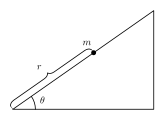
Write down the Lagrangian and determine the equations of motion. Solve the resulting equation for "r" to obtain the expression for r(t).
How fast and in what direction must galaxy A be moving if an absorption line found at wavelength 550\text{ nm} (green) for a stationary galaxy is shifted to 450\text{ nm} for galaxy A and how fast and in what direction is galaxy B moving if the same line is shifted to 700\text{ nm} for it ?
A three-particle system consists of masses \text{m}_i,\ i = 1, 2, 3 and their respective coordinates (\text{x}_i, \text{y}_i, \text{z}_i) : m_1 = 3m,\ (x_1, y_1, z_1) = (a, 0, a), m_2 = 4m,\ (x_2, y_2, z_2) = (a, a, -a), m_3 = 2m,\ (x_3, y_3, z_3) = (-a, a, 0), where m and a are positive constants. Calculate the inertia tensor of the system.
A mouse of mass m jumps on the outside edge of a freely turning ceiling fan of rotational inertia I and radius R. By what ratio does the angular velocity change ?
A particle moves in an elliptical orbit in an inverse-square-law central force field. If the ratio of the maximum angular velocity to the minimum angular velocity of the particle in the orbit is n, then show that the eccentricity of the orbit is \varepsilon = \frac{\sqrt{n} - 1}{\sqrt{n} + 1}.
In special theory of relativity, the Hamiltonian of a free particle with rest mass m_0 is given by \sqrt{p^2 c^2 + m_0^2 c^4}. Obtain the Lagrangian of the system using Legendre transformation.
A particle of mass m is constrained to move on a plane curve xy=c with c>0, under gravity, where y-axis is vertical. Construct the Lagrangian of the system and obtain the Euler-Lagrange equation of motion.
A particle moving in a central force field located at r=0, describes a spiral, r=e^{-\theta}. Find the force law.
Consider a homogeneous cube of total mass M and side a. Taking the origin at one corner of the cube and axes along the edges of the cube, construct the moment of inertia tensor. Calculate principal moment of inertia.
Calculate the first relativistic correction to the kinetic energy of a particle with rest mass m_0 and speed v.
Show that the wave equation for the propagation of electromagnetic scalar potential \phi(x, y, z, t) \left[\nabla^2 - \frac{1}{c^2} \frac{\partial^2}{\partial t^2}\right] \phi(x, y, z, t) = 0 remains invariant under Lorentz transformation.
State the fundamental postulates of Einstein's special theory of relativity. Deduce Lorentz transformation equation and discuss how this accounts for the phenomenon of length contraction.
Show that the relativistic invariance laws of conservation of momentum lead to the concepts of variation of mass with velocity and mass energy equivalence.