(i) Using the laws of transformation of the electric field, \vec{\text{E}}, and the magnetic field, \vec{\text{B}}, show that (\text{E}^2 - \text{C}^2 \text{B}^2) is relativistically invariant. (ii) Suppose that in one inertial frame \vec{\text{B}} = 0 but \vec{\text{E}} \neq 0 (at some point P). Is it possible to find another inertial frame in which the electric field is zero at P ?
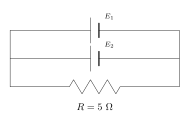
Two cells \text{E}_1 of E.M.F. 2\text{ volts} and internal resistance 1\cdot 5\text{ ohms} and \text{E}_2 of E.M.F. 1\cdot 5\text{ volts} and internal resistance 1\text{ ohm}, are joined in parallel with like poles together (see the figure below). Calculate the current that would pass through a 5\text{-ohm} resistance joined in parallel with the cells.
A uniformly charged sphere of radius R carries a total charge Q. Find the net force that the southern hemisphere exerts on the northern hemisphere. Express your answer in terms of the radius R and total charge Q.
A charge of -3\cdot 30\ \mu\text{C} is fixed in place. From a horizontal distance of 0\cdot 0455\text{ m}, a particle of mass 7\cdot 35 \times 10^{-3}\text{ kg} and charge -7\cdot 45\ \mu\text{C} is fired with an initial speed of 62\cdot 5\text{ m/s} directly towards the fixed charge. How far does the particle travel before it comes to rest ?
Explain Planck's formula for black-body radiation. Use this formula to show that energy radiated per unit time per unit area in the range d\lambda of \lambda is e(\lambda, T) = \left( \frac{2\pi c^2 h}{\lambda^5} \right) (e^{\beta hc / \lambda} - 1)^{-1} d\lambda
(i) Show that the electric and magnetic energy densities in a plane travelling wave are equal. Also prove that the total energy density = \varepsilon_0 E^2 = \mu_0 H^2.
(ii) Deduce the equation of continuity based on Maxwell's equations.
In free space, the electric field of electromagnetic wave is given by \vec{E}(x, t) = 100 \cos (\omega t - kx) \hat{y}\text{ volt/metre} Find the average power crossing a circular area of radius 2\text{ metres} in the yz-plane.
There is a potential gradient of 100\text{ V/m} normal to the surface of the earth. Assuming the earth to be a charged sphere of radius 6370\text{ km}, find the total charge on the earth.
(i) The equation for an alternating current is I = 42\cdot 42 \sin (314t). Find the following : Maximum value of current, Frequency, RMS value and Average value
(ii) A condenser of capacity 1~\mu\text{F} is first charged and then discharged through a resistance of 1\text{ M}\Omega. Calculate the time in which the charge on the condenser will fall to 50\% of its initial value.
(iii) Consider the displacement vector \vec{D}, given by \vec{D} = (10xyz^2 + 4x)\hat{i} + (5x^2 z^2)\hat{j} + (10x^2 yz)\hat{k}\text{ nC/m}^2 Find the total charge enclosed in a cube of volume 10^{-9}\text{ m}^3 located at the point (1, 2, 3).
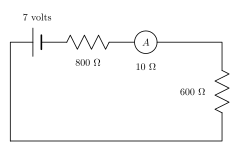
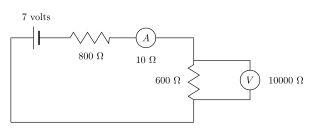
Two resistors of 600~\Omega and 800~\Omega are connected in series with a 7\text{ volts} battery. An ammeter of 10~\Omega resistance is used to measure current.
(i) What will be the reading in the ammeter?
(ii) Similarly if a voltmeter of 10000~\Omega resistance is used to measure the potential difference across the 600~\Omega resistor, what will be the reading in the voltmeter?
Obtain an expression for the electric potential and electric field strength at a point due to an electric dipole.
State and explain Biot-Savart law. Obtain an expression for the magnetic field at the center of a circular loop of radius r metres, carrying a current of I amperes.
Using the set of four Maxwell's equations, obtain the Lorentz condition relation between the scalar potential \phi and vector potential A, i.e., \nabla \cdot A + \frac{1}{c^2} \frac{\partial \phi}{\partial t} = 0 and discuss the gauge transformations, Lorentz gauge and Coulomb gauge.
Construct the Hamiltonian of a charged particle with charge q and mass m moving with the velocity \vec{v} in the external electromagnetic field, \vec{E}=E_0 \hat{i}, \vec{B}=B_0 \hat{k}, where E_0 and B_0 are constants.
(i) State Faraday's law of electromagnetic induction and prove that it can be expressed in the following vector form : \mathrm{Curl}~\vec{E} = -\frac{\partial \vec{B}}{\partial t} with \vec{E} and \vec{B} being the electric and magnetic fields. (ii) A coil of 10 turns has dimension 9~\text{cm} \times 7~\text{cm}. It rotates at the rate of 15\pi~\text{rad/sec} in a uniform field whose flux density is 0\cdot 6~\text{weber/m}^2. What is the maximum e.m.f. induced in the coil ?
In a one-dimensional device, the charge density is given by \rho_V = \rho_0 \frac{x}{a}. If E = 0 at x = 0 and V = 0 at x = a, find V and E using Laplace equation of electrostatics.
State and explain the Biot-Savart law. Derive an expression for the magnetic field at a point due to an infinitely long straight current carrying conductor.
Use the method of electric images to find the electric field on the surface of a grounded conducting sphere.
Write down the four Maxwell's equations and explain the contribution of Maxwell in the development of these equations.
(i) Using Maxwell's equations, obtain the relation \frac{1}{c} \frac{\partial}{\partial t} \left( \frac{E^2 + B^2}{2} \right) + \vec{\nabla} \cdot (\vec{E} \times \vec{B}) = 0 (ii) What is Poynting vector ? Deduce Poynting theorem for the flow of energy in an electromagnetic field.