A cell of internal resistance 1\,\text{ohm}, 1.5 volt e.m.f. and another cell of internal resistance 2\,\text{ohm}, 2 volt e.m.f. are connected in parallel across the ends of an external resistance of 5\,\text{ohm}. Find the current in each branch of the circuit.
Starting from the Laplace's equation in a cylindrical polar coordinate system and using the method of separation of variables, obtain the differential equations for the solutions of r, \phi and z components of the potential.
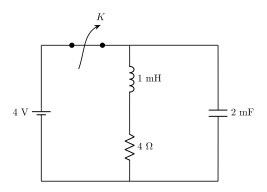
Consider the R-L-C circuit shown here. Calculate the Q-factor of the circuit. Does the circuit have a resonant frequency? Justify your answer:
A current sheet having \vec{K} = 9.0a_y\,\mathrm{A\,m^{-1}} is located at z = 0. The interface is between the region 1, z < 0, \mu_{r1} = 4, and region 2, z > 0, \mu_{r2} = 3. Given that \vec{H}_2 = 14.5a_x + 8.0a_z\,\mathrm{A\,m^{-1}}. Find \vec{H}_1 and \vec{B}_1.
Write down Maxwell's equations in a non-conducting medium with constant permeability and susceptibility (\rho = j = 0). Show that \vec{E} and \vec{B} each satisfies the wave equation, and find an expression for the wave velocity. Write down the plane wave solutions for \vec{E} and \vec{B}, and show how \vec{E} and \vec{B} are related.
A metal guitar string with a length of 70\,\mathrm{cm} vibrates at its fundamental frequency of 246.94\,\mathrm{Hz} in a uniform magnetic field of 10\,\mathrm{T} oriented perpendicular to the plane of vibration of the string. Assume a sinusoidal form for the amplitude of the vibrational mode, and a maximum displacement of 3\,\mathrm{mm} at the centre of the string. What is the maximum e.m.f. generated across the length of the guitar string, and at what point in time in the string's motion does that occur? What would be the e.m.f. if the same guitar string vibrates at its second harmonic frequency? Briefly explain.
The spectral composition of solar radiation is similar to that of a black body radiator whose maximum emission corresponds to the wavelength 0.48\,\mu\mathrm{m}. Find the mass lost by the Sun every second due to radiation. Evaluate the time interval during which the mass of the Sun reduces by 1 per cent. Given: Stefan Boltzmann constant = 5.669 \times 10^{-8}\ \mathrm{W\,m^{-2}\,K^{-4}}, radius of the Sun = 6.957 \times 10^{8}\ \mathrm{m}, surface temperature of the Sun = 5772\ \mathrm{K} and mass of the Sun is 1.9885 \times 10^{30}\ \mathrm{kg}.
Given that the electric potential of a system of charges is V=\dfrac{12}{r^2}+\dfrac{1}{r^3} volt. Calculate the electric field vector at the Cartesian point (4,2,3)\,\mathrm{m}.
Calculate the skin depth of electromagnetic waves of 1\,\mathrm{MHz} incident on a good conductor having \sigma = 5.8 \times 10^{7}\,\mathrm{S\,m^{-1}}. Assume that inside the conductor \mu = \mu_0 = 4\pi \times 10^{-7}\,\mathrm{H\,m^{-1}}.
Given an infinite line charge of charge density 2\,\mathrm{nC\,m^{-1}} parallel to the y-axis and passing through the point (3,0,4)\,\mathrm{m} and an infinite sheet of charge of charge density 4\,\mathrm{nC\,m^{-2}} parallel to the x-y plane and passing through the point (0,0,6)\,\mathrm{m}. Calculate the electric field intensity at the point (10,10,10)\,\mathrm{m}. Assume free space.
A region 1, z<0, has a dielectric material with \varepsilon_r=3.2 and a region 2, z>0 has a dielectric material with \varepsilon_r=2.0. Let the displacement vector in the region 1 be, \vec{D}_1=-30a_x+50a_y+70a_z\,\mathrm{nC\,m^{-2}}. Assume the interface charge density is zero. Find in the region 2, the \vec{D}_2 and \vec{P}_2, where \vec{P}_2 is the electric polarization vector in the region 2.
A rod of length l is perpendicular to a uniform magnetic field \mathrm{B}. The rod revolves at an angular speed \omega about an axis passing through one end of the rod and parallel to the magnetic field \mathrm{B}. Find the voltage induced across the rod's ends.
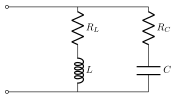
Consider the two branch parallel circuit shown in the diagram. Determine the resonant frequency of the circuit.
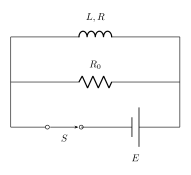
In the given circuit, L=2.0\,\mu\mathrm{H}, R=1.0\,\Omega, R_0=2.0\,\Omega and E=3.0\,\mathrm{V}. Find the amount of heat generated in the coil after the switch S is disconnected. The internal resistance of the source is negligible.
Using the two-fluid model of a conductor (normal and superconducting) and the Maxwell's equations, derive the two London equations of superconductivity.
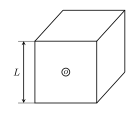
A historic failure of Classical Physics is its inability to describe the electromagnetic radiation emitted from a black body. Consider a simple model for an ideal black body consisting of a cubic cavity of side L with a small hole on one side. Assuming the classical equipartition of energy, derive an expression for the average energy per unit volume and unit frequency range. In what way does this result deviate from actual observation? What is this law called?
Repeat the calculations now using quantum idea to obtain an expression that properly accounts for the observed spectral distribution. Find the temperature dependence of the total power emitted from the hole.
Write expressions for divergence and curl of an electrostatic field. From these, obtain Poisson and Laplace equations. Two concentric conducting spherical shells having radii r_1 and r_2 (r_1<r_2) are charged to potentials V_1 and V_2, respectively. What are the electric potential and hence electric field in the space between the shells? Also find the charge on the inner shell.
In a certain cyclotron, the maximum radius that the path of a deuteron may have before it is deflected out of the magnetic field is 20\,\mathrm{cm}.
(i) Calculate the velocity of the deuteron at this radius.
(ii) What is the energy of deuteron in \mathrm{MeV}? Given, magnetic field =1500 gauss and mass of deuteron =3.34\times10^{-27}\,\mathrm{kg}.
A 10\Omega resistor is connected in series with a capacitor of 1.0\mu\mathrm{F} and a battery with emf 12.0 V. Before the switch is closed at time t=0, the capacitor is uncharged. Calculate the following:
(i) The time constant.
(ii) What fraction of the final charge is on the plates at the time t=46 seconds?
(iii) What fraction of the initial current remains at the time t=46 seconds? Consider that the internal resistance of the battery is zero and neglect the resistance of all the connecting wires.
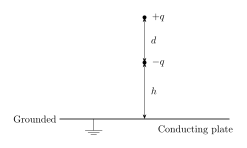
A vertically oriented electric dipole having dipole moment \vec{p} is kept at height h above an infinitely large horizontal conducting plate, which is grounded as shown in the diagram. Calculate the force between the electric dipole and the conducting plate by using method of images.