
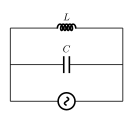
A parallel LC circuit is operated at a frequency \omega, which is less than the resonant frequency \omega_0 of the LC circuit. Explain whether the reactance is inductive or capacitive.
cse-2003-subject-03-005
A parallel LC circuit is operated at a frequency \omega, which is less than the resonant frequency \omega_0 of the LC circuit. Explain whether the reactance is inductive or capacitive.
Define Poynting vector and explain its significance. The electric field vector for an electromagnetic field travelling in vacuum is given by \vec{E} = E_0 \cos (kz - \omega t) \hat{i} Calculate the Poynting vector for the wave and show that its magnitude is equal to the energy density of the wave time the velocity of light.
A plane wave of frequency \omega, which into two linear dielectric media. It has a normal incidence at the interface of the media. Giving appropriate for the intensities of reflected and transmitted rays.
Earth receives 1.3\text{KW/m}^2 of radiant energy from the Sun. Assuming Sun to be a spherical black body of radius 7 \times 10^8\text{m} and Earth-sun distance to be 1.5 \times 10^{11}\text{m}, Calculate the surface temperature of Sun. (Stefan-Boltzmenn constant \sigma = 5.67 \times 10^{-8}\text{ Wm}^{-2}\text{K}^{-4}).
Show that a sprining nucleus precesses in a magnetic field. Explain the underlying principle of NMR spectroscopy. The magnetic moment of a position is 2.793 \mu\text{ N}. Calculate the radio frequency at which nuclear magnetic resonance occurs in water kept in a magnetic field of T.
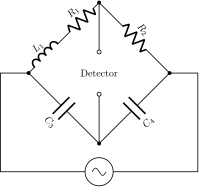
A bridge network with resistance, capacitance and inductance is given in the above figure. Show that the conditions for balancing the bridge are independent of the frequency of applied voltage.
A cylinder of length L and radius b has its axis coincident with z-axis. The electric held in th region is E = 100 k. Find the electric flux through (i) the top circular end (ii) the bottom circular end (iii) the curved wall of the cylinder (iv) the closed surface of the cylinder
What is Laplace equation ? Determine the average electric potential over a spherical surface, due to a point charge q placed at a distance r from the centre of the sphere. Assume r to be greater than the radius of the sphere.
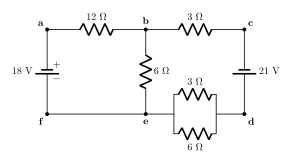
Using Kirchhoff's laws find currents in each branch of the circuit shown in the following diagram.
A bulb filament is constructed from a tungsten wire of length 2\text{ cm} and diameter 50\text{ }\mu\text{m}. It is enclosed in a vacuum bulb. What temperature does it reach when it is operated at a power of 1 watt? Given:
(i) Emissivity of tungsten \varepsilon = 0.4
(ii) Stefan's constant \sigma = 5.67 \times 10^{-8}\text{ watt/m}^2\text{ K}^4.
What are vector and scalar potentials for the electromagnetic field? Are they unique? Explain what are Coulomb's and Lorentz gauges. Derive the electromagnetic wave equation in Lorentz gauge and show that it is equivalent to Maxwell's equation.
Why did Maxwell have to introduce the idea of displacement current? Derive the wave equation from Maxwell's laws. Obtain Fresnel's formula for reflection and transmission coefficients of the electric vector when it is perpendicular to the plane of incidence.
A series LCR circuit with \mathrm{L} = 2\text{ H}, \mathrm{C} = 2\text{ }\mu\text{F} and \mathrm{R} = 20\\ \Omega is powered by a source of 100\text{ volts} and variable frequency. Find
(i) the resonance frequency, f_0,
(ii) the value of Q
(iii) the width of resonance \Delta f and
(iv) the maximum current at resonance.
A Geiger tube consists of a wire a wire of radius 0.2\text{ mm} and length 12\text{ cm} and a co-axial metallic cylinder of radius 1.5\text{ cm} and length 12\text{ cm}. Find
(i) the capacitance of the system, and
(ii) the charge per unit length of the wire when the potential difference between the wire and the cylinder is 1.2\text{ kV}. (Assume the dielectric constant of the gas in the tube to be 1)
Show that the potential energy of a charge Q uniformly distributed throughout the sphere of radius R is given by PE = \frac{3}{5} \frac{Q^2}{4\pi\varepsilon_0 R}
Calculate the electric field for a point on the axis of a uniform ring of a charge 'q' and radius a. Show that the maximum value occur at x = \pm a/2.
Explain the use of a parallel resonance circuit
(i) as a rejector circuit
(ii) for current amplification.
An inductance is connected to 6 volt battery through a resistance R. What is the steady state current in the circuit? Alter what time the battery would be delivering one half its steady state current?
What value of inductance has to be used so that a lamp with rating of 200 volt and 10 Amperes lights the same way with 250 V source at 50 Hz.
A conducting sphere of radius `a' is placed in a uniform electric field E_0. Using the method of images, show that the potential function is given by \phi = -E_0 \left(r - \frac{a^3}{r^2}\right) \cos \theta.