Comment Done
Navigation
HomePYQs Question BankCSE Physics OptionalIFoS Physics OptionalBlog & InsightsCourses & ProgrammesMy Courses (Candidate Portal)
Account
/
20 questions visible on this page

Starting from Maxwell's equations of electromagnetic field in vacuum obtain the classical wave equations for the four field vectors \vec{E}, \vec{D}, \vec{B} and \vec{H} . Show that the field vectors can be propagated as waves in free space with the velocity of propagation equal to 3 \times 10^8\text{ m/s}, where for free space we have the vacuum permittivity \varepsilon_o = 8.854 \times 10^{-12}\text{ farad/m} & vaccum permeability \mu_o = 1.257 \times 10^{-6}\text{ henry/m}.

CSE 2006Paper I20 markscse-2006-subject-03-006

Using Planck's radiation formula u(\nu) d\nu = \frac{8 \pi h}{c^3} \frac{\nu^3 d\nu}{e^{h\nu/kT} - 1} where the symbols have their usual meaning, find the wavelength of the region where energy density is the greatest. Also calculate the total energy density over all the frequencies

CSE 2006Paper I20 markscse-2006-subject-03-009

In the case of proton NMR, state the expression for the energy of the dipole in an external magnetic field. How does the NMR originate ? Give the rough range of frequencies of the NMR signals, and the normal magnitude of the applied field.

CSE 2006Paper I30 markscse-2006-subject-03-010
  1. (a) Consider two long and straight current carrying wires placed parallel to each other a certain distance apart. Derive an expression for the force per unit length experienced by these wires. Discuss that the attractive (repulsive) nature of this force is related to the directions of flow of currents in the two wires.
CSE 2005Paper I30 markscse-2005-subject-03-002

(b) Derive approximate expressions for the potential and the radial as well as the azimuthal components of the field due to an electric dipole at points far away from it. Also derive expression and hence describe the effect of a unifrom electric field on a dipole which can rotate freely.

CSE 2005Paper I30 markscse-2005-subject-03-003

(b) Show that the electric and magnetic field vectors, \vec{E} and \vec{B}, in plane electromagnetic waves are mutually perpendicular in a plane normal to the direction of propagation. How are phases of \vec{E} and \vec{B} related to each other ?

CSE 2005Paper I20 markscse-2005-subject-03-004
  1. (a) Write down the macroscopic form of the Maxwell's equations in any isotropic (but inhomogeneous) medium and define the symbols appearing therein. Convert these equations in the integral forms to highlight the laws represented by these equations.
CSE 2005Paper I25 markscse-2005-subject-03-005

(c) Use the Planck formula for the blackbody radiation u(\omega, T) = \frac{\hbar^2}{\pi^2 c^3} \frac{\omega^3}{\exp(\beta \hbar \omega) - 1} with \beta = \frac{1}{k_B T} to derive Wien's law, Rayleigh-Jeans law and Stefan-Boltzmann law.

CSE 2005Paper I20 markscse-2005-subject-03-007

(b) Describe physical significance of the displacement current considering the example of current flow through a capacitor.

CSE 2005Paper I15 markscse-2005-subject-03-006

(a) Prove the relation \nabla^2 \left( \frac{1}{|\vec{r} - \vec{r}'|} \right) = - 4 \pi \delta \left(|\vec{r} - \vec{r}'|\right) and hence show that \phi(\vec{r}) = \int \frac{\rho(\vec{r}')}{|\vec{r} - \vec{r}'|} \, d\vec{r}' is a solution of the Poisson equation \nabla^2 \phi(\vec{r}) = - 4 \pi \rho(\vec{r}).

CSE 2005Paper I20 markscse-2005-subject-03-001

What do you understand by a perfect black body? Can it be realised in practice ? Show that the ratio of the emissive power to the absorptive power for all bodies at a given temperature is equal to the emissive power of a perfectly black body.

CSE 2004Paper I20 markscse-2004-subject-03-009

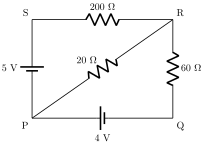
A network PQRS is connected as shown in the figure below. Apply Kirchhoff's law and show that the current flowing through the 20\ \Omega resistor PR is 0.029 A.

Physics Diagram cse-q-3-226-fig-1
CSE 2004Paper I20 markscse-2004-subject-03-003

A point charge q is held at a distance d in front of an infinite grounded conducting plane. What is the electric potential in front of the plane ?

CSE 2004Paper I20 markscse-2004-subject-03-004

Find out the magnetic field inside a long solenoid carrying current i and having n turns per unit length.

CSE 2004Paper I20 markscse-2004-subject-03-005

What are the vector and scalar potentials ? Derive Maxwell's wave equations in terms of these potentials.

CSE 2004Paper I20 markscse-2004-subject-03-006

Define the strength of a magnetic shell and calculate the magnetic potential at any neighbouring point due to this shell. Does the potential depend on the shape of the shell ?

CSE 2004Paper I20 markscse-2004-subject-03-001

Show that the Poynting vector \bar{S} = (\bar{E} \times \bar{H}) represents the energy flow per unit area per unit time both in magnitude and direction in case of a plane electromagnetic wave.

CSE 2004Paper I20 markscse-2004-subject-03-007

Given the temperature of the Sun's surface T = 5755\text{ K}, radius of the Sun 6.9 \times 10^5\text{ km}, distance between the Earth and the Sun 1.5 \times 10^8\text{ km}. Estimate the solar constant (i.e. the energy received per sec per unit area of the Eath's surface). Assume \sigma = 5.7 \times 10^{-8}\text{ W/m}^2\text{-K}^4.

CSE 2004Paper I20 markscse-2004-subject-03-008

What is the volume density of the charge in a region of space, where the electrostatic potential is given by V = a - b (x^2 + y^2) - c \ln (x^2 + y^2), where a, b, c are constants ?

CSE 2004Paper I20 markscse-2004-subject-03-002

Consider an infinite grounded conducting plane. If a point charge is held at a distanced d from the plane, compute by method of images, the electric potential above the plane and the induced charges on the conductor.

CSE 2003Paper I20 markscse-2003-subject-03-003

Document & Diagram Scanner

Clean whiteboard & high-contrast scan with automatic image enhancement

Filter:
-- × -- pxCompressed: -- KB--% saved