
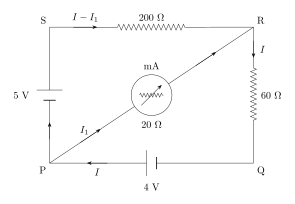
In the circuit diagram shown below, calculate the current passing through the milliammeter.
cse-2013-subject-03-003
In the circuit diagram shown below, calculate the current passing through the milliammeter.
Consider the following coupled inductor - capacitor circuit:
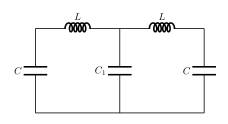
Calculate the ratio of the frequencies of the anti-symmetric and symmetric modes \omega_a/\omega_s. \left(\text{Given } k=\frac{1}{LC},\ k'=\frac{1}{LC_1}\right)
Consider the equation for a series RLC circuit and compare this to the parallel resonant circuit shown below:
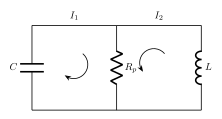
Calculate the value of R_p if a series RLC circuit and the parallel RLC circuit are to have same equations for the potential of capacitance while they both have the same L, C and Q with Q being the total charge.
What do you understand by the term polarization in dielectrics ? Obtain Clausius-Mossotti formula for linear dielectrics.
A series LCR circuit has resonant frequency \omega_0 and a large quality factor Q. Write down in terms of R, \omega, \omega_0 and Q, its (i) impedance at resonance, (ii) impedance at half-power points and (iii) the approximate forms of its impedance at low and high frequencies.
A long straight solenoid has 100 turns in the secondary and 3000 turns per centimeter in the primary. The area of cross-section of the solenoid is 3 square centimeters. Calculate the mutual inductance.
Explain the term 'mutual inductance' between two coils carrying current. Describe a method of determining mutual inductance between two coils of wire with relevant theory.
The volume between two concentric conducting spherical surfaces of radii a and b (a<b) is filled with an inhomogeneous dielectric with \epsilon=\epsilon_0/(1+cr), where c is a constant and r is the radial coordinate. A charge +Q is placed on the inner surface, while the outer surface is grounded. Determine-
(i) \vec{D} in the region a<r<b;
(ii) capacitance of the device;
(iii) polarization charge density in the region a<r<b;
(iv) surface polarization charge densities at r=a and r=b.
Assume \vec{E}=0 inside a perfect conductor. Elaborate on any other four electrostatic properties that arise from this property.
A resistance R and a lossless capacitor C are connected through a switch. The capacitor is charged to potential V_0, and the switch is closed at t = 0. Prove that the energy stored in the capacitor is equal to the energy dissipated in the resistor.
Find out the number of photons in a cavity of volume 1\cdot 00\text{ cm}^3 under thermal equilibrium at temperature T = 1000\ {}^\circ\text{K}. Assume that \int_0^\infty \frac{x^2 dx}{e^x - 1} = 2\cdot 405.
What is a displacement current? Prove that lines of conduction current plus displacement current are continuous.
The dielectric constant of a medium is 3. The Electric field in the dielectric is 10^6\text{ Vm}^{-1}. What are the electric displacement and polarization ?
Explain the physical significance of the Poynting vector \bar{S}. What is represented by the closed integral \oint \bar{S} \cdot d\bar{a} for a closed surface of area \bar{a} ?
If considered a blackbody as a radiation-filled cavity at a uniform temperature T, demonstrate with an appropriate figure the electromagnetic wave patterns inside the cavity of length L for wavelengths \lambda = L, \frac{3}{2} L and 2L.
Show that the complex propagation constant k of an electromagnetic wave propagating in an isotropic dielectric medium with conductivity \sigma can be given by k = k_r + i k_i with k_r \approx \frac{2\pi}{\lambda_o} n \left[ 1 + \frac{1}{8} \left( \frac{\sigma}{\omega \varepsilon} \right)^2 \right] and k_i \approx \frac{2\pi}{\lambda_o} n \left[ \frac{1}{2} \left( \frac{\sigma}{\omega \varepsilon} \right) \right] where n = \sqrt{\varepsilon / \varepsilon_o} and \lambda_o = \omega / 2\pi c; \varepsilon and c being the permittivity of the dielectric and velocity of light in free space, respectively.
For the above system, show that the energy per unit cavity volume in the frequency range of \nu and \nu + d\nu can be given by u(\nu)d\nu = \frac{8\pi\nu^2 k_B T}{c^3} d\nu where k_B is the Boltzmann's constant. Discuss the limitations of this formula and how did Planck put forward the correct analysis.
How do you justify the statement : "A current carrying conductor, although has no net charge experiences a force when placed in a magnetic field."
Consider Maxwell's equation in differential form in media. For j=\rho=0, assume \epsilon=\epsilon_0e^{\alpha t} and \mu=\mu_0e^{\alpha t} and show that the relevant wave equation for a plane wave propagating along x-direction is \frac{\partial^2 E}{\partial x^2}=\mu\frac{\partial^2 D}{\partial t^2}+\mu\alpha\frac{\partial D}{\partial t} where \vec{E}=E\hat{y} and \vec{H}=H\hat{z}.
Prove that the Maxwell's equations in a medium contain the conservation of charge in differential form.