
Compute the electrostatic energy of a conducting solid sphere of radius R and having total charge Q using the expression for the electrostatic energy in terms of the electric field \bar{E} of the above sphere.
ifos-2014-subject-03-003
Compute the electrostatic energy of a conducting solid sphere of radius R and having total charge Q using the expression for the electrostatic energy in terms of the electric field \bar{E} of the above sphere.
A sphere of homogeneous linear dielectric material is placed in an otherwise uniform electric field \bar{E}_o. Find the electric field inside the sphere.
Suppose a cavity of volume V contains blackbody radiation in equilibrium with the walls of the cavity at a temperature T. For a reversible adiabatic change of volume show that : VT^3 = \text{constant}. If the initial temperature is 2000^\circ\text{K} and the volume is increased from 10\text{ cm}^3 to 1250\text{ cm}^3, reversibly and adiabatically, what would be the final temperature of the radiation ?
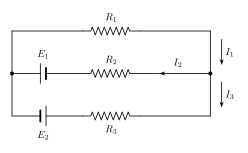
Explain Kirchoff's circuit laws. Using Kirchoff's laws find currents I_1, I_2 and I_3 in the circuit shown below for R_1 = 100\ \Omega, R_2 = 200\ \Omega, R_3 = 300\ \Omega, E_1 = 3\text{ V}, E_2 = 4\text{ V}.
Prove Stefan's law of radiation from thermodynamic considerations.
An inductance L, capacitance C and resistance R are connected in series to form a circuit with AC source driving with E_{\text{rms}} = 120\text{ V} at f = 60\text{ Hz}. Compute the power factor and average power dissipated in the resistance if R = 200\ \Omega, X_L = 80\ \Omega and X_C = 150\ \Omega.
A plane electromagnetic wave of frequency w_1 travelling in z-direction and polarized in x-direction is incident on a dielectric medium separated by a plane boundary in the x-z plane. Show that the transmission and reflection coefficient are given by : R = \frac{(n_1 - n_2)^2}{(n_1 + n_2)^2} , \quad T = \frac{4 n_1 n_2}{(n_1 + n_2)^2} , where n_1 and n_2 are the refractive indices of the first and the second medium.
(i) Write Maxwell's equations in the absence of a medium. (ii) Explain the gauge transformation and gauge invariance. Show that the relation \text{div } \bar{A} + \frac{1}{c} \frac{\partial \phi}{\partial t} is Lorentz-covariant, where \bar{A} and \phi are the vector potential and the scalar potential respectively. (iii) Obtain Maxwell's wave equations satisfied by the scalar and vector potentials in the absence of charge and current.
(i) Considering an isotropic, linear, non-conducting, non-magnetic and inhomogeneous dielectric medium with \vec{D}=\epsilon\vec{E}=\epsilon_0n^2(x,y,z)\vec{E}, show that the electromagnetic wave equation for the field \vec{E} is given by \nabla^2\vec{E}+\vec{\nabla}\left(\frac{1}{n^2}\vec{\nabla}n^2\cdot\vec{E}\right)-\mu_0\varepsilon_0n^2\frac{\partial^2\vec{E}}{\partial t^2}=0.
(ii) Write down the scalar equation for E_x from the above equation.
(iii) Interpret physically the situation if we move from homogeneous to an inhomogeneous medium.
(iv) Obtain the similar vector equation for the magnetic field \vec{H} in inhomogeneous medium.
For a uniform wire of length L and radius a having a potential difference V between the ends and a current I along it, calculate the energy per unit time delivered to the wire by Poynting vector.
The electric field of a plane e.m. wave travelling along the z-axis is \vec{E}=(E_{0x}\hat{x}+E_{0y}\hat{y})\sin(\omega t-kz+\phi). Determine the magnetic field.
A series LCR circuit has resonant frequency \omega_0 and a large quality factor Q. Write down in terms of R, \omega, \omega_0 and Q, its (i) impedance at resonance, (ii) impedance at half-power points and (iii) the approximate forms of its impedance at low and high frequencies.
Consider the equation for a series RLC circuit and compare this to the parallel resonant circuit shown below:
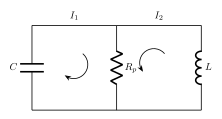
Calculate the value of R_p if a series RLC circuit and the parallel RLC circuit are to have same equations for the potential of capacitance while they both have the same L, C and Q with Q being the total charge.
Consider the following coupled inductor - capacitor circuit:
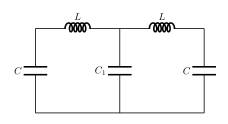
Calculate the ratio of the frequencies of the anti-symmetric and symmetric modes \omega_a/\omega_s. \left(\text{Given } k=\frac{1}{LC},\ k'=\frac{1}{LC_1}\right)
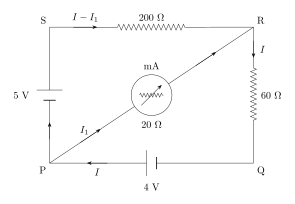
In the circuit diagram shown below, calculate the current passing through the milliammeter.
ABCD is a rectangle in which charges of +10^{-11}\,\mathrm{C}, -2\times10^{-11}\,\mathrm{C} and 10^{-11}\,\mathrm{C} are placed at corners B, C and D, respectively.
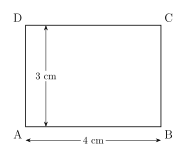
Calculate the potential at the corner A and the work done in carrying a charge of 2 coulombs to A.
Using the fundamental concepts of electromagnetism, determine the electric field of an electric dipole \vec{p} at a distance \vec{r} and its energy in an electric field \vec{E}.
Show that Wien's law and Stefan-Boltzmann law are limiting cases of Planck's radiation law.
Define a black body. How can we realise a black body in practice ? Derive expression for Planck's radiation law.
What do you understand by the term polarization in dielectrics ? Obtain Clausius-Mossotti formula for linear dielectrics.