
Write down Maxwell's equations for linear dielectrics and deduce the equation of continuity.
cse-2016-subject-03-005
Write down Maxwell's equations for linear dielectrics and deduce the equation of continuity.
(i) Derive Planck's law of Black body radiation. (ii) Obtain its limiting forms for (i) very low frequency and (ii) very high frequency.
Show that for any electromagnetic wave propagating in free space, the total average energy per unit volume is \frac{1}{2}\epsilon_0 E_{\text{max}}^2; where E_{\text{max}} is the amplitude of the electric field associated with the electromagnetic wave.
State and prove Poynting's theorem.
If the magnetic field \vec{B}, at a point with position vector \vec{r} is uniform, show that the corresponding vector potential \vec{A}(\vec{r}) is given by \vec{A}(\vec{r}) = -\frac{1}{2} \left[ \vec{r} \times \vec{B} \right]
Show that Maxwell's equations of electrodynamics are invariant under Lorentz transformations.
A point charge of q is held above a grounded conducting plane located at z = 0. If the position of the charge is (0, 0, d), obtain an expression for the induced charge density on the plane as a function of the coordinates x and y.
With the help of a neat diagram, show that the potential due to a dipole at a point is given by V=\frac{1}{4\pi\epsilon_0}\,\frac{p\cos\theta}{r^2}, where p is the dipole moment of the charge distribution, \theta is the angle between the line joining the centre of the dipole to the point of interest and the axis of the dipole.
An inductor L = 0.1\text{ H} in series with a resistor R = 20\ \Omega is connected across 230\text{ V}, 50\text{ Hz} a.c. voltage. Determine the following : (i) inductive reactance (ii) impedance of the circuit (iii) current in the circuit (iv) voltage across R (v) voltage across L (vi) phase angle between the current and voltage (vii) power factor (viii) power consumed in the circuit
(i) Show that the work done per unit volume of a ferromagnetic substance per one complete cycle of hysteresis is given by W = \oint \vec{H} \cdot d\vec{B} (ii) Further, show that the value of W is equal to the area of B-H loop. Which material is preferred for the core of a transformer and why ?
What is the volume density of charge in a region of space where electrostatic potential is given by V = a - b(x^2 + y^2) - c\log(x^2 + y^2), where a, b, c are constants.
What are the characteristic features of Rayleigh scattering? A very thin monochromatic beam of light is incident on a particle. Suggest a simple experimental method to ascertain whether the scattering by the particle is of Rayleigh type.
Derive the equation that represents Poynting's theorem. What is its physical significance?
A radio station transmits electromagnetic waves isotropically with an average power of 200\,\mathrm{kW}. Determine the average magnitude of the maximum electric field at a distance of 5\,\mathrm{km} from it.
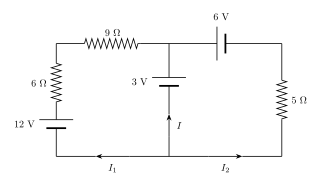
In the circuit given below, find the values of currents I_1, I_2 and I.
A plane electromagnetic wave propagating along +\hat{z} direction is incident normally on the boundary at z=0 between medium A(z<0) and medium B(z>0). Determine the reflection coefficient and transmission coefficient for the wave.
A conducting sphere of radius 5\,\mathrm{cm} has a total charge of 12\,\mathrm{nC} uniformly distributed on its surface in free space. Determine the displacement vector \vec{D} on its surface and outside at a distance r from the centre of the sphere.
A series RLC circuit has a resistance of 100\Omega and an impedance of 210\Omega. If this circuit is connected to an a.c. source with an r.m.s. voltage of 220\ \mathrm{V}, how much is the average power dissipated in the circuit?
A plane conducting circular wire loop lies perpendicular to a uniform magnetic field B and its area S(t) is changed as S(t) = S_0 (1 - \alpha t), where 0 < t < \frac{1}{\alpha} (S_0 and \alpha are constants). The wire has resistance per unit length \rho\,\Omega\text{ m}^{-1}. Find the induced current through the wire. If the current in a certain coil varies at a rate of 50\text{ A s}^{-1}, the induced e.m.f. is V = 20\text{ volts}. What is the inductance of the coil?
Two spheres A and B having same temperature T are kept in the surroundings of temperature T_0. Consider T > T_0. The spheres are made of same material but have different, radii r_A and r_B. Using Stefan - Boltzmann distribution, determine which of these will lose heat by radiation faster.